The Correct Answer and Explanation is:
Based on the document provided, here are the correct answers and a detailed explanation.
Correct Answers
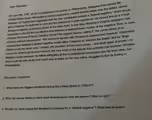
- What were the biggest problems facing the United States in 1786-87?
The biggest problem was a fundamental power struggle between the states and the weak national government. The new nation was “struggling to find its footing” because the central government lacked the authority to “restrain the states” and defend national interests against laws passed at the state level. - Why do you think Madison might have been frustrated with the Articles of Confederation?
Madison was likely frustrated with the Articles of Confederation because they created an ineffective and weak central government. His proposal for a “federal negative,” which would give Congress the power to veto any state law, demonstrates his belief that the nation needed a much stronger federal authority than the Articles provided. - Would you have supported Madison’s proposal for a ‘federal negative’? Why or why not?
No, I would not have supported the proposal. While Madison’s goal of a stronger union was valid, giving the federal government an absolute veto over all state legislation would concentrate too much power centrally. This could suppress the unique needs and voices of individual states, creating a system that was just as unbalanced as the one it sought to replace.
Explanation
The document highlights a critical moment in American history, the Constitutional Convention of 1787, where the nation’s future structure was fiercely debated. The central issue, as the text reveals, was the distribution of power. The United States, then operating under the Articles of Confederation, was failing. The Articles had established a weak national government that could not effectively manage the country, leading to the problems Madison sought to solve. His frustration stemmed from this weakness. Under the Articles, states acted like independent nations, often passing laws that conflicted with national interests or harmed neighboring states. The federal government was powerless to intervene.
Madison’s proposed solution, the “federal negative,” was a radical one. He argued it was a “‘proper & necessary’ defense of national power,” a tool to forge a cohesive nation from thirteen disparate states. From his perspective, a central authority needed the ultimate power to veto state laws to prevent chaos and ensure uniformity. This would allow Congress to “restrain the states” and prevent them from undermining the union. Supporters would have seen this as a logical step toward creating a stable and powerful country capable of standing on the world stage.
However, this proposal was ultimately rejected, and for good reason. Granting Congress an absolute veto over any law passed by a state legislature would have destroyed the principle of state sovereignty. Many delegates feared creating a new national government that was just as tyrannical as the British monarchy they had fought to escape. They believed that states, being closer to the people, were better equipped to handle local affairs. A federal negative would have placed immense, and perhaps unchecked, power in the hands of the national legislature. The final Constitution instead created a more nuanced balance through the Supremacy Clause, which makes federal law supreme over conflicting state law, but without giving Congress a blanket veto over all state actions. This compromise preserved a role for state governments while establishing a stronger, more effective federal system.