The Correct Answer and Explanation is:
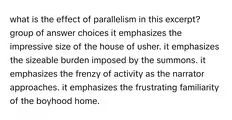
Based on the answer choices provided, which strongly suggest the text is from Edgar Allan Poe’s “The Fall of the House of Usher,” the correct answer is: it emphasizes the sizeable burden imposed by the summons.
Here is a 300 word explanation:
This answer is correct because the use of parallelism in the story’s opening paragraphs directly contributes to the heavy, oppressive atmosphere that reflects the narrator’s psychological state. The narrator has arrived at the house in response to a “wildly importunate” summons from his ailing friend, Roderick Usher. This summons is a significant emotional and psychological weight, a “sizeable burden,” even before he sees the house.
When the narrator first beholds the scene, Poe employs parallelism to list the grim details that create a sense of “insufferable gloom.” For example, he looks “upon the mere house,” “upon the bleak walls,” “upon the vacant eye-like windows,” and “upon a few white trunks of decayed trees.” This repetitive grammatical structure forces the reader to absorb each desolate feature individually, yet also as part of a cumulative, overwhelming whole. The effect is not simply descriptive; it is psychological. Each parallel phrase adds another layer to the narrator’s “utter depression of soul.”
This literary technique makes the external environment a mirror of the narrator’s internal burden. The oppressive weight of the house, built up through the relentless, parallel listing of its decaying parts, becomes a physical manifestation of the burden he feels from his friend’s desperate plea. The parallelism emphasizes that his task is not just a simple visit; it is an entry into a world of physical and mental decay, a heavy responsibility he has undertaken. The other options are less accurate. The emphasis is on the house’s oppressive character, not just its size. The scene is marked by a “soundless” stillness, not a frenzy of activity. Finally, the narrator’s feeling is one of profound gloom, not frustrating familiarity with a boyhood home.