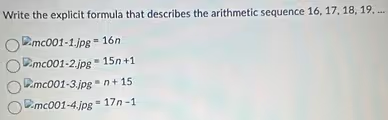
The Correct Answer and Explanation is:
The correct answer is the third option: aₙ = n + 15
Here is a detailed explanation of how to arrive at this answer.
An explicit formula allows you to find any term in an arithmetic sequence without having to list all the terms before it. The standard explicit formula for an arithmetic sequence is aₙ = a₁ + (n – 1)d, where:
- aₙ represents the value of the nth term you want to find.
- a₁ is the very first term in the sequence.
- n is the position of the term in the sequence (1st, 2nd, 3rd, and so on).
- d is the common difference, which is the constant value added to get from one term to the next.
First, let’s identify the components from the given sequence: 16, 17, 18, 19, …
- Find the first term (a₁): The sequence begins with 16, so a₁ = 16.
- Find the common difference (d): To find the common difference, subtract any term from the one that follows it.
- 17 – 16 = 1
- 18 – 17 = 1
- 19 – 18 = 1
The common difference is consistent, so d = 1.
- Substitute the values into the formula: Now, we place the values of a₁ (16) and d (1) into the explicit formula aₙ = a₁ + (n – 1)d.
- aₙ = 16 + (n – 1) * 1
- Simplify the expression: The final step is to simplify the equation through algebraic manipulation.
- aₙ = 16 + n – 1 (distributing the 1 does not change the terms in the parenthesis)
- aₙ = n + 16 – 1
- aₙ = n + 15
This simplified formula, aₙ = n + 15, is the explicit formula for the sequence. We can test it to be sure. For the first term (n=1), the formula gives 1 + 15 = 16. For the second term (n=2), it gives 2 + 15 = 17. These results match the original sequence, confirming the formula is correct.