The Correct Answer and Explanation is:
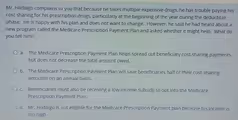
The correct answer is a. The Medicare Prescription Payment Plan helps spread out beneficiary cost-sharing payments but does not decrease the total amount owed.
Here is a detailed explanation:
You should inform Mr. Hidalgo that the Medicare Prescription Payment Plan is designed precisely for situations like his. The program, which began in 2025 as part of the Inflation Reduction Act, allows Medicare Part D beneficiaries to smooth their out-of-pocket prescription drug costs over the course of the year.
The primary function of this plan is to address the financial burden of high upfront costs, particularly during the deductible phase at the beginning of the year. Instead of paying a large lump sum at the pharmacy, a beneficiary can elect to pay their cost-sharing in fixed monthly installments. This helps with budgeting and cash flow but does not change the total amount of money the beneficiary is responsible for paying for their prescriptions over the entire year. Therefore, option A is the most accurate description of the program’s benefit.
The other options are incorrect for specific reasons. Option B is false because the plan is a payment management tool, not a savings or discount program. It does not reduce the total annual cost-sharing amount by half or any other percentage. Option C is also incorrect. Eligibility for the payment plan is not restricted to those receiving the Low Income Subsidy (Extra Help). It is available to any Medicare Part D enrollee who is not receiving the subsidy and expects to have high out-of-pocket costs. Finally, option D is the opposite of the plan’s intent. The program is especially useful for beneficiaries with a deductible, as it helps manage the significant expense required to meet it. The presence of a deductible makes a person a prime candidate for the plan, not ineligible for it.