The Correct Answer and Explanation is:1
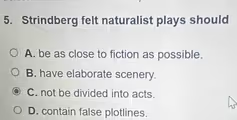
The correct answer is C. not be divided into acts.
August Strindberg was a pioneering figure in theatrical Naturalism, a movement that sought to portray life on stage with scientific objectivity and realism. His most influential ideas on the subject are detailed in the preface to his 1888 play, Miss Julie. In this text, Strindberg argued for a radical reformation of theatrical conventions to better serve the goal of creating a perfect illusion of reality, a “slice of life.”
A central part of his argument was the abolition of the traditional act structure. Strindberg believed that dividing a play into acts, with intermissions in between, was an artificial device that destroyed the dramatic illusion. It allowed the audience to pause, reflect, and escape the author’s intended hypnotic effect. He felt that real life does not have convenient breaks. By presenting a drama as a single, continuous piece of action, the theater could achieve a more intense and immersive experience, forcing the audience to confront the characters’ psychological and social struggles without interruption. This unbroken format was crucial for maintaining the sense of real time and relentless pressure that defined the naturalist aesthetic.
The other options are incorrect. Naturalism aimed for reality, not to be “close to fiction” (A). While naturalist sets were realistic, Strindberg favored authentic, even stark, environments over “elaborate scenery” (B), which could feel artificial. Finally, “false plotlines” (D) are a form of dramatic manipulation, directly opposing the naturalist goal of presenting an unadorned, truthful depiction of human existence shaped by heredity and environment.