The Correct Answer and Explanation is:
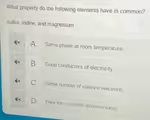
The correct answer is A. Same phase at room temperature.
Here is a detailed explanation:
The question asks for a common property among the elements sulfur (S), iodine (I), and magnesium (Mg). To determine the correct answer, we must analyze the physical and chemical properties of each element and evaluate them against the given options.
The correct option is A because all three elements are solids at room temperature, which is typically defined as about 20 to 25 degrees Celsius (68 to 77 degrees Fahrenheit).
- Magnesium (Mg) is an alkaline earth metal. Like the vast majority of metals, with mercury being a notable exception, magnesium exists as a solid at room temperature. It is a lightweight, silvery-white metal.
- Sulfur (S) is a nonmetal. In its most stable elemental form, it is a bright yellow, crystalline solid at room temperature.
- Iodine (I) is a halogen. While it is known for sublimating, which is the process of turning directly from a solid to a gas, it is a solid at standard room temperature. It appears as a lustrous, grayish-black crystalline solid.
Since all three elements are found in the solid state under normal conditions, they share the same phase.
The other options are incorrect for the following reasons:
B. Good conductors of electricity: This property is not shared. Magnesium, as a metal, is an excellent conductor of both heat and electricity. However, sulfur and iodine are nonmetals, which are characteristically poor conductors of electricity and are often used as insulators.
C. Same number of valence electrons: This statement is false. The number of valence electrons, or the electrons in the outermost shell of an atom, determines an element’s chemical properties and its group in the periodic table.
- Magnesium is in Group 2, so it has two valence electrons.
- Sulfur is in Group 16, so it has six valence electrons.
- Iodine is in Group 17, so it has seven valence electrons.
As they have different numbers of valence electrons, they do not share this property.