The Correct Answer and Explanation is:
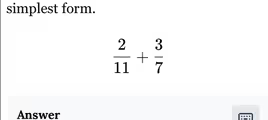
Correct Answer: 47/77
To find the sum of 2/11 and 3/7, we need to perform fraction addition. A key rule for adding fractions is that they must have the same denominator. In this problem, the denominators are 11 and 7, which are different. Therefore, the first step is to find a common denominator, ideally the least common multiple (LCM) of 11 and 7.
Since both 11 and 7 are prime numbers, their least common multiple is simply their product.
Least Common Denominator = 11 × 7 = 77.
Next, we must convert each fraction into an equivalent fraction with the denominator of 77.
For the first fraction, 2/11, we need to determine what to multiply the denominator (11) by to get 77. That number is 7. To maintain the value of the fraction, we must multiply both the numerator and the denominator by 7:
(2 × 7) / (11 × 7) = 14/77.
For the second fraction, 3/7, we need to multiply the denominator (7) by 11 to get 77. We do the same to the numerator:
(3 × 11) / (7 × 11) = 33/77.
Now that both fractions have a common denominator, we can add their numerators and place the sum over the common denominator:
14/77 + 33/77 = (14 + 33) / 77 = 47/77.
The final step is to simplify the resulting fraction, as requested by the prompt. To simplify 47/77, we look for any common factors between the numerator (47) and the denominator (77). The number 47 is a prime number, meaning its only factors are 1 and 47. The factors of 77 are 1, 7, 11, and 77. Since there are no common factors other than 1, the fraction 47/77 is already in its simplest form.
