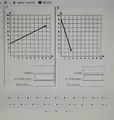
The Correct Answer and Explanation is:
Of course. Here are the correct answers for the graphs, followed by a detailed explanation.
Correct Answers
For Graph A:
- SPEED: 0.5
- Y-INTERCEPT: 2
- EQUATION: y = 0.5x + 2
For Graph B:
- SPEED: 3
- Y-INTERCEPT: 9
- EQUATION: y = -3x + 9
Explanation
The two images show distance-time graphs, which are used to represent an object’s motion. The vertical axis (y-axis) represents the distance from a starting point, and the horizontal axis (x-axis) represents time. The information requested for each graph can be found by analyzing the properties of the straight line.
Analysis of Graph A:
The line in Graph A is moving upward from left to right, which indicates that the object is moving away from its origin at a constant speed.
- Y-Intercept: The y-intercept is the point where the line crosses the vertical y-axis. This point represents the object’s initial distance at time zero (x=0). By looking at the graph, we can see the line starts at the point (0, 2). Therefore, the y-intercept is 2.
- Speed: In a distance-time graph, the speed of the object is represented by the slope of the line. The slope is calculated as the “rise over run,” or the change in the y-values divided by the change in the x-values. We can pick two distinct points on the line to calculate this. Let’s use the starting point (0, 2) and the ending point (10, 7).
- Slope (Speed) = (y₂ – y₁) / (x₂ – x₁) = (7 – 2) / (10 – 0) = 5 / 10 = 0.5.
- The speed is 0.5 units of distance per unit of time.
- Equation: The equation of a straight line is given by the formula y = mx + b, where ‘m’ is the slope (speed) and ‘b’ is the y-intercept. Using the values we found:
- m = 0.5
- b = 2
- The equation for the line in Graph A is y = 0.5x + 2.
Analysis of Graph B:
The line in Graph B is moving downward from left to right, indicating the object is moving back toward its origin at a constant speed.
- Y-Intercept: Similar to the first graph, we find the y-intercept where the line crosses the y-axis (at x=0). The line begins at the point (0, 9), so the y-intercept is 9.
- Speed: We calculate the slope to find the velocity. The line passes through points (0, 9) and (3, 0).
- Slope = (y₂ – y₁) / (x₂ – x₁) = (0 – 9) / (3 – 0) = -9 / 3 = -3.
- The negative sign indicates the direction of motion is toward the origin. Speed, however, is a scalar quantity that measures magnitude, not direction, so it cannot be negative. We take the absolute value of the slope. The speed is |-3| = 3.
- Equation: We use the formula y = mx + b with the slope and y-intercept we determined.
- m = -3
- b = 9
- The equation for the line in Graph B is y = -3x + 9.