The Correct Answer and Explanation is:
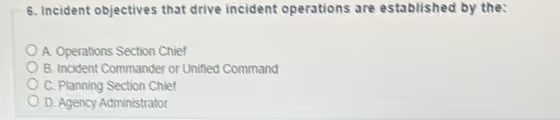
The correct answer is B. Incident Commander or Unified Command.
The establishment of clear incident objectives is a foundational principle of the Incident Command System (ICS). These objectives provide the overarching strategy and direction for all response activities. The ultimate responsibility for setting these crucial objectives lies with the person or group in charge of the incident, which is either the Incident Commander (IC) or a Unified Command (UC).
The Incident Commander is the single individual who holds the primary authority and responsibility for managing the entire incident. Upon arriving and assuming command, one of the IC’s first critical tasks is to assess the situation, understand the scope of the problem, and establish specific, measurable, achievable, relevant, and time-bound (SMART) objectives. These objectives dictate the overall goals of the response, such as ensuring life safety, stabilizing the incident, and protecting property and the environment.
In more complex incidents that involve multiple jurisdictions or agencies, a Unified Command is established. This structure brings together representatives from the major agencies involved to make decisions jointly. The Unified Command collectively establishes a single set of incident objectives, ensuring that all participating agencies are working toward the same goals and preventing conflicting actions.
The other roles listed serve different functions. The Operations Section Chief is responsible for the tactical implementation of the objectives. They manage the hands on work and direct the resources to achieve the goals set by command. The Planning Section Chief supports the IC or UC by gathering and analyzing information, tracking resources, and formalizing the objectives into a written Incident Action Plan (IAP). However, they do not create the objectives themselves. An Agency Administrator is a higher level official who provides policy guidance and delegates authority to the IC but is not typically involved in establishing the specific operational objectives for the on scene response. Therefore, the authority to define what needs to be accomplished during an incident rests solely with the Incident Commander or Unified Command.