The Correct Answer and Explanation is:
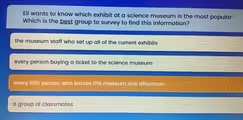
The correct answer is every fifth person who leaves the museum one afternoon.
To find out which exhibit is the most popular, it is essential to survey a group that represents the general population of museum visitors. This is called a representative sample. The best method among the choices is to survey every fifth person who leaves the museum. This approach is effective for two main reasons. First, it targets the correct population: people who have actually visited the museum and experienced the exhibits. Their opinions are based on direct experience, which is necessary to judge popularity. Second, selecting every fifth person is a technique called systematic sampling. This method helps to create a random and unbiased sample of visitors from that specific time, preventing the surveyor from only choosing people who look friendly or are easy to approach.
The other options are unsuitable because they would lead to biased or irrelevant information. Surveying the museum staff would not reflect the public’s opinion. Staff members have an insider’s perspective and may be partial to exhibits they helped create or know are technically complex, which may not align with what visitors enjoy most. They are not the target audience for this survey.
Asking every person buying a ticket is also a poor strategy. These individuals have not yet seen the exhibits, so they can only comment on their expectations, not their actual experience. The goal is to measure experienced popularity, not anticipated interest.
Finally, surveying a group of classmates is a highly biased method. This is a convenience sample that is not representative of all museum visitors. Classmates are likely of a similar age and background, and their preferences would not capture the opinions of the wider, diverse audience that visits a science museum, which includes families, children, seniors, and tourists. Therefore, the most statistically sound choice is to survey a random sample of visitors after they have completed their visit.