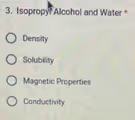
The Correct Answer and Explanation is:
The correct answer is Solubility.
Solubility is the property that best describes the interaction between isopropyl alcohol and water. This term refers to the ability of one substance, the solute, to dissolve in another substance, the solvent, to form a homogeneous mixture called a solution. In the case of isopropyl alcohol and water, they are completely soluble in one another in any proportion, a specific type of solubility known as miscibility.
The reason for this high solubility lies in their molecular structures and the resulting intermolecular forces. Both water (H₂O) and isopropyl alcohol (C₃H₈O) are polar molecules. A water molecule has a significant separation of charge, with the oxygen atom being partially negative and the hydrogen atoms being partially positive. This polarity allows water molecules to form strong intermolecular attractions with each other called hydrogen bonds.
Similarly, isopropyl alcohol has a polar hydroxyl group, an -OH group, attached to its carbon chain. This -OH group behaves much like a water molecule, with a partially negative oxygen and a partially positive hydrogen. This feature enables isopropyl alcohol to also form hydrogen bonds.
When the two liquids are mixed, the polar hydroxyl group of the isopropyl alcohol can readily form new hydrogen bonds with the polar water molecules. The formation of these new alcohol-water bonds is energetically favorable and effectively overcomes the hydrogen bonds that existed between the water molecules themselves and between the alcohol molecules themselves. Because they can interact so strongly with each other, they mix easily to form a uniform solution. The other options are incorrect because density is an intrinsic property of each substance, while magnetic properties and conductivity are not the primary characteristics governing their ability to mix.
