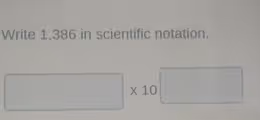
The Correct Answer and Explanation is:
Here is the correct answer for the problem:
First box: 1.386
Second box: 0
The complete expression in scientific notation is 1.386 x 10⁰.
Explanation
Scientific notation is a standard way to write numbers, especially very large or very small ones, in a concise format. The general form is a × 10ᵇ, where ‘a’ is the coefficient and ‘b’ is the integer exponent. There are two key rules for writing a number in proper scientific notation. First, the coefficient ‘a’ must be a number greater than or equal to 1 but less than 10 (1 ≤ |a| < 10). Second, the exponent ‘b’ must be an integer, representing the power of 10.
The task is to write the number 1.386 in this form.
First, we need to determine the coefficient ‘a’. We do this by adjusting the decimal point in the original number until there is only one non-zero digit to its left. In the number 1.386, the decimal point is already correctly placed. The digit ‘1’ is the single non-zero digit to the left of the decimal point. The number 1.386 itself satisfies the condition for the coefficient, as it is greater than or equal to 1 and less than 10. Therefore, our coefficient ‘a’ is 1.386.
Next, we must find the exponent ‘b’. The exponent indicates how many places we moved the decimal point to obtain the coefficient. A positive exponent means we moved the decimal to the left, and a negative exponent means we moved it to the right. In this particular case, we did not need to move the decimal point at all because the original number, 1.386, was already in the correct format for the coefficient. Moving the decimal point zero places corresponds to an exponent of 0.
To verify our answer, we can calculate the value of our scientific notation expression. Any number raised to the power of 0 is equal to 1, so 10⁰ = 1. Thus, 1.386 × 10⁰ is the same as 1.386 × 1, which equals 1.386. This matches our original number, confirming that the conversion is correct.