The Correct Answer and Explanation is:
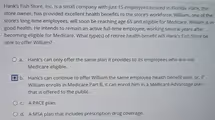
The correct answer is b. Hank’s can continue to offer William the same employee health benefit and, if William enrolls in Medicare Part B, it can enroll him in a Medicare Advantage plan that is offered to the public.
Here is an explanation:
The key factor in this scenario is the size of Hank’s Fish Store. With only 15 employees, the business falls under the small employer exception to the Medicare Secondary Payer (MSP) rules. These federal rules, which typically apply to employers with 20 or more employees, mandate that the employer’s group health plan must be the primary payer for active employees, with Medicare paying second.
Because Hank’s has fewer than 20 employees, the opposite is true. For William, an active employee over age 65, Medicare becomes the primary insurance payer, and the employer’s health plan becomes the secondary payer. This gives Hank’s Fish Store more flexibility in the health benefits it can offer William.
Option B correctly identifies two valid paths. First, Hank’s can allow William to remain on the existing company health plan. In this case, the plan would supplement his Medicare coverage, likely paying for costs after Medicare has paid its primary share. This is a common arrangement for small businesses.
Second, the option notes that Hank’s could help enroll William in a Medicare Advantage (MA) plan. Small employers are increasingly using this strategy. They can offer a group Medicare Advantage plan, which is a private health plan that replaces Original Medicare and often includes prescription drug coverage. This approach can be more cost effective and provide well-coordinated benefits for both the employer and the employee. The phrasing “offered to the public” simply refers to the fact that these plans are administered by the same private insurance companies that offer individual MA plans.
The other options are incorrect. Option A is false because the word “only” is too restrictive; small employers have multiple options. Option C is incorrect because PACE plans are for frail individuals needing a nursing home level of care, which does not describe the healthy and active William. Option D is incorrect because Medicare Medical Savings Account (MSA) plans are rare and typically do not include integrated prescription drug coverage.