The Correct Answer and Explanation is:
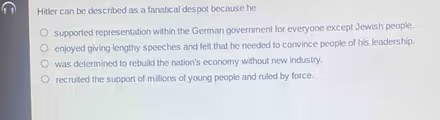
The correct answer is that Hitler “recruited the support of millions of young people and ruled by force.”
This statement accurately captures the dual nature of Hitler’s regime as described by the term “fanatical despot.” A despot is a ruler with absolute power who governs in an oppressive or cruel manner. A fanatic is an individual filled with excessive, single minded zeal, often for a political or religious cause. Hitler’s leadership embodied both of these characteristics.
The “ruled by force” part of the answer directly addresses his despotic nature. Upon becoming Chancellor, Hitler systematically dismantled the democratic Weimar Republic. He used the Reichstag Fire Decree and the Enabling Act of 1933 to seize absolute authority, effectively ending civil liberties. He established a totalitarian state where political opposition was brutally suppressed. His power was enforced by terror organizations like the Gestapo, the SS, and the SA. Opponents, real or perceived, were imprisoned in concentration camps, tortured, or executed without trial. This reliance on violence, intimidation, and the complete suppression of dissent is the hallmark of a despot.
The “recruited the support of millions of young people” element highlights his fanaticism. Hitler did not rule by force alone; he cultivated a fervent ideological movement. Through powerful propaganda and organizations like the Hitler Youth and the League of German Girls, the Nazi party indoctrinated an entire generation. Young people were taught to have unquestioning loyalty to Hitler and the Nazi worldview, which was based on racial purity, antisemitism, and aggressive nationalism. This created a mass base of zealous followers who were willing to enforce his fanatical vision, further enabling his despotic control over Germany. The other options are incorrect because Hitler destroyed representative government, his economic policies heavily relied on new industry for rearmament, and his speeches were a tool of his despotism, not its defining feature.