The Correct Answer and Explanation is:
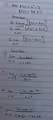
Based on the handwritten notes in the image, here is the transcription of the mathematical problems and their solutions.
Problem 1
lim (x→∞) [√(x² + x + 1) – √(x² – x + 1)]
= 1
Cara Cepat (Quick Method) for Problem 1
Given the form lim (x→∞) [√(ax² + bx + c) – √(px² + qx + r)], if a = p, the limit is (b – q) / (2√a).
Here, a=1, b=1, c=1 and p=1, q=-1, r=1.
Since a=p, the formula applies:
(1 – (-1)) / (2√1) = 2 / 2 = 1
Problem 2
lim (x→0) [x tan(3x) / sin²(6x)]
= 1/12
Problem 3
lim (x→∞) [(2x² + 3x) / √(x⁴ – x)]
= 2
Explanation
The provided image displays handwritten solutions to three distinct calculus problems involving limits. Each solution employs standard techniques appropriate for the form of the limit.
The first problem is a limit at infinity that presents an indeterminate form of ∞ minus ∞. The standard approach, shown in the notes, is to multiply the expression by its conjugate, which is √(x² + x + 1) + √(x² – x + 1). This algebraic manipulation removes the square roots from the numerator, leaving a simplified expression of 2x. The next step involves dividing both the numerator and denominator by the highest power of x, which is x. As x approaches infinity, terms like 1/x and 1/x² approach zero. This simplification leads to the final result of 2 / (√1 + √1), which equals 1. The notes also show a shortcut formula for this specific type of limit, confirming the same answer.
The second problem is a limit as x approaches zero involving trigonometric functions, resulting in the indeterminate form 0/0. The strategy used is to rewrite the expression sin²(6x) as sin(6x) * sin(6x) and then separate the fraction into a product of two simpler limits: [x / sin(6x)] and [tan(3x) / sin(6x)]. The solution then applies fundamental trigonometric limit identities, where lim (x→0) x/sin(ax) = 1/a and lim (x→0) tan(ax)/sin(bx) = a/b. Applying these rules, the limits of the individual parts are 1/6 and 3/6, respectively. Multiplying these results gives the final answer of 1/12.
The third problem is another limit at infinity, this time with a rational expression. To solve this, one must identify the highest power of x in the overall expression. In the denominator, √(x⁴) is equivalent to x². Therefore, both the numerator and the denominator are divided by x². This transforms the expression into (2 + 3/x) / √(1 – 1/x³) As x approaches infinity, the terms 3/x and 1/x³ go to zero, simplifying the expression to 2 / √1, which results in the final answer of 2.