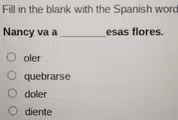
The Correct Answer and Explanation is:
The correct answer to fill in the blank is oler.
The completed sentence is “Nancy va a oler esas flores,” which translates to “Nancy is going to smell those flowers.” This choice is correct both grammatically and logically.
The Spanish sentence structure “ir + a + infinitive” is used to express the near future, equivalent to the English “going to [do something]”. In this sentence, “Nancy va a” means “Nancy is going to,” and it must be followed by an infinitive verb, which is the base form of a verb ending in ar, er, or ir. “Esas flores” (“those flowers”) is the direct object of the action. The verb “oler” means “to smell,” which is a logical action to perform on flowers. As an infinitive verb, it fits the grammatical structure perfectly.
Let’s analyze why the other options are incorrect.
Quebrarse means “to break” or “to shatter.” The “se” at the end makes it a reflexive verb, indicating the action happens to the subject. “Nancy va a quebrarse” would mean “Nancy is going to break herself,” which does not make sense with the object “esas flores.”
Doler means “to hurt” or “to ache.” This verb functions differently in Spanish, much like the verb “gustar.” The thing causing pain is the subject, and the person feeling the pain is an indirect object. For example, “A Nancy le duelen los pies” (Nancy’s feet hurt). You cannot “doler” an object directly, so this choice is grammatically incorrect in this context.
Diente is the Spanish word for “tooth.” This is a noun, not a verb. The grammatical construction requires an infinitive verb to follow “va a,” so placing a noun here would create a nonsensical and grammatically flawed sentence.
Therefore, “oler” is the only option that is an infinitive verb and creates a meaningful, correct sentence.