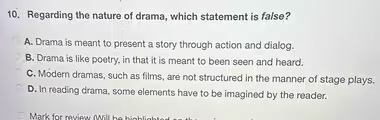
The Correct Answer and Explanation is:
The correct answer is C.
This statement is false because modern dramas, including films, frequently are structured in the manner of stage plays. While filmmaking incorporates unique cinematic techniques like camera angles, editing, and special effects, the underlying narrative framework often follows traditional dramatic principles. The most common structure used in both modern screenplays and classic plays is the three-act structure. This framework organizes the story into a beginning, a middle, and an end, typically labeled as Act I (Setup), Act II (Confrontation), and Act III (Resolution).
Within this structure, both films and stage plays utilize similar components to build the narrative. They establish the setting and characters (exposition), introduce a conflict that drives the plot forward (inciting incident), build tension through a series of obstacles (rising action), reach a peak point of conflict (climax), and then resolve the story (falling action and resolution). Screenplays, much like the scripts for plays, are broken down into scenes that advance the plot and develop characters. Because of these shared fundamental structural elements, it is incorrect to state that films are not structured in the manner of stage plays.
The other statements are true. Statement A provides a core definition of drama as a story told through performance. Statement B is also accurate; drama is a performance art meant to be seen and heard, and in this way, it shares characteristics with poetry, which has a strong oral tradition and relies on sound and rhythm. Statement D is correct because when reading a play’s script, the reader must use their imagination to visualize the non-dialogue elements such as the set, costumes, lighting, and the actors’ physical performances and emotional expressions, which are only suggested by stage directions.