The Correct Answer and Explanation is:
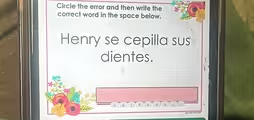
The error in the sentence is the word sus. The correct word is los.
The corrected sentence is: Henry se cepilla los dientes.
Explanation
The original sentence, “Henry se cepilla sus dientes,” contains a common grammatical error often made by English speakers learning Spanish. The mistake involves the redundant use of a possessive adjective (“sus”) with a reflexive verb when referring to body parts.
In Spanish, when the subject of a sentence performs an action on themselves, a reflexive verb is used. In this case, the verb is “cepillarse” (to brush oneself). The pronoun “se” attached to the verb “cepilla” is a reflexive pronoun, indicating that the subject, Henry, is performing the action on himself.
Because the reflexive pronoun “se” already makes it clear that Henry is brushing his own teeth, adding the possessive adjective “sus” (his) is unnecessary and grammatically incorrect. It creates a redundancy, similar to saying “Henry brushes for himself his teeth” in English.
The correct grammatical structure in Spanish for this situation is to use a definite article (“el,” “la,” “los,” or “las”) instead of a possessive adjective before the body part or item of clothing. Since “dientes” (teeth) is a masculine, plural noun, the correct definite article is “los.”
Therefore, the proper sentence is “Henry se cepilla los dientes.” The construction “se cepilla los dientes” correctly conveys that Henry is brushing the teeth that belong to him without needing the possessive adjective. This rule applies broadly to similar actions, such as “me lavo las manos” (I wash my hands) or “te pones la chaqueta” (you put on your jacket). Mastering this distinction is a key step toward speaking Spanish more fluently and naturally.