Classify evolutionary evidence Classify each example into the correct evolutionary evidence category Homologous structure Amino acid sequence Distinct species on Similarities in DNA sequences of vertebrate forelimbs differences between two species either side of Wallace’s line Similarities in the Distribution of fossilsVestigial structures on five continents species Biogeography Anatomy Molecular comparisons Development
The correct answer and explanation is:
Classification of Evolutionary Evidence
- Homologous Structure → Similarities in the anatomy of vertebrate forelimbs
Homologous structures are anatomical features that different species inherit from a common ancestor, even if they serve different functions. Vertebrate forelimbs, such as those in humans, whales, bats, and birds, share similar bone structures (humerus, radius, and ulna) despite being adapted for different activities like grasping, swimming, and flying. This suggests a common evolutionary origin. - Amino Acid Sequence → Differences between two species
Comparing amino acid sequences in proteins like cytochrome c or hemoglobin can reveal evolutionary relationships. The fewer differences in amino acids between two species, the closer they are related. Conversely, larger differences indicate a more distant common ancestor. - Similarities in DNA Sequences → Molecular comparisons
DNA comparisons provide precise evidence for evolutionary relationships. Species with more similar DNA sequences share a more recent common ancestor, while species with greater genetic differences diverged earlier in evolutionary history. - Distinct species on either side of Wallace’s Line → Biogeography
Wallace’s Line is a boundary separating Asian and Australian faunas. The stark difference in species on either side suggests that geographical barriers led to independent evolutionary paths, supporting the idea that species distribution is influenced by historical geographic events. - Similarities in the distribution of fossils on five continents → Biogeography
Fossil evidence found on different continents supports continental drift and evolution. For example, similar fossils of Mesosaurus in Africa and South America indicate these continents were once connected. - Vestigial Structures → Anatomy
Vestigial structures are body parts that have lost their original function through evolution. Examples include the human appendix, whale pelvis, and snake remnants of hind limbs, all of which point to ancestral traits that have been reduced over time.
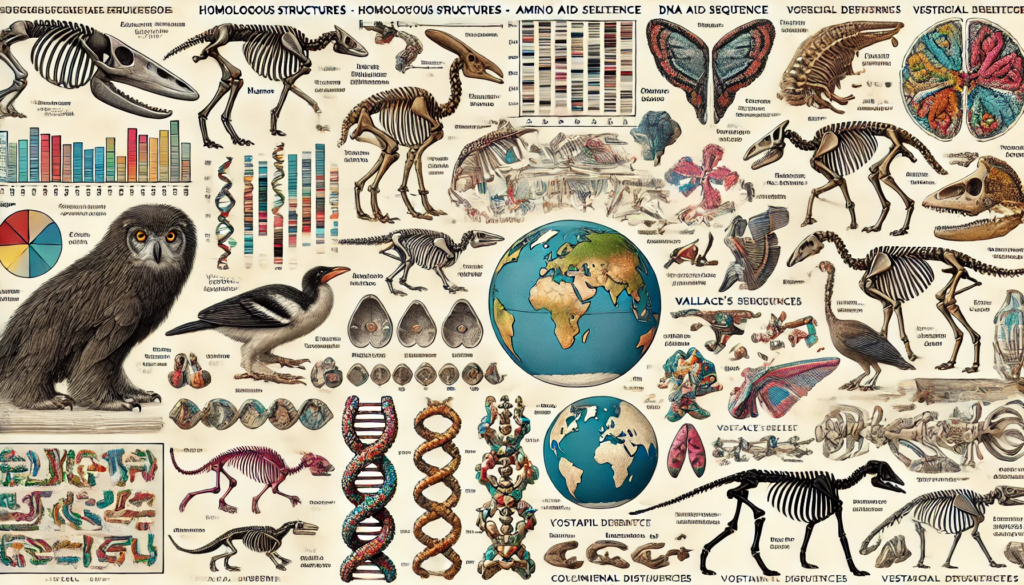
Now, I’ll generate an image illustrating these evolutionary evidence categories.
Here is the detailed scientific illustration showcasing different types of evolutionary evidence. Let me know if you need any modifications or further explanations!